
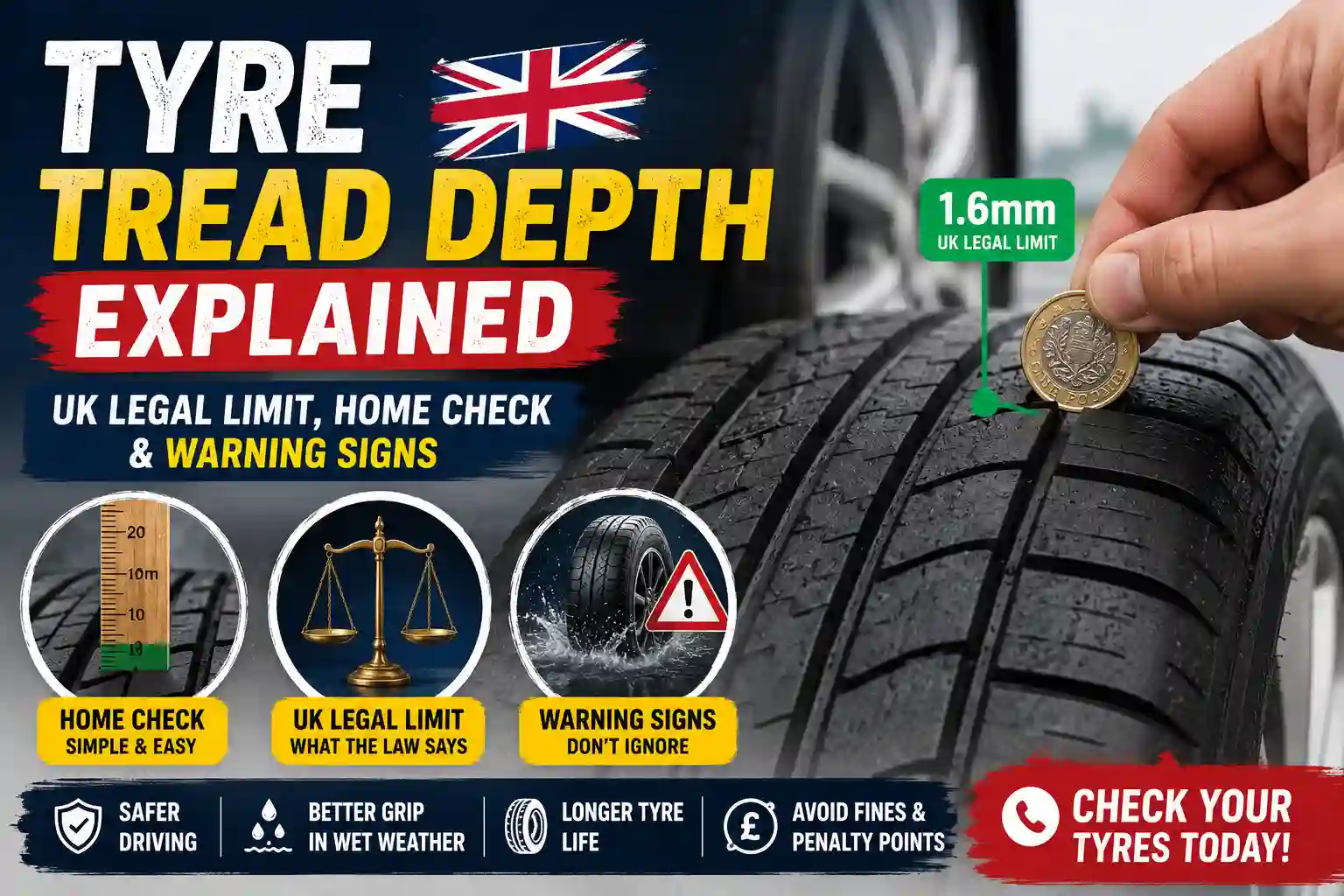
Most UK drivers have heard of the 1.6mm minimum tread depth rule, but very few actually know what that looks like on a real tyre, how quickly a tyre gets there, or why waiting until you reach it is a bad idea. The legal minimum is exactly that — a legal line, not a safe one. Long before your tyres drop to 1.6mm, your stopping distance on a wet road is already increasing.
This guide covers everything you need to know: the law, how tread actually works, how to check it yourself at home, what different wear patterns mean, and when a worn tyre stops being a “replace soon” job and becomes an emergency. If cold weather is on your mind too, our winter tyre safety guide covers what changes once temperatures drop.
What Does Tyre Tread Actually Do?
The grooves and channels cut into a tyre aren’t just for grip — their main job is moving water out from under the tyre so the rubber can stay in contact with the road. On a bone-dry road, a completely smooth tyre would actually grip better, which is why race cars use slicks. But British weather doesn’t give us that luxury.
A tyre with healthy tread can clear around 8 litres of water per second at 50mph. As the tread wears down, that drainage ability drops sharply. By the time you hit the legal minimum, your tyre’s ability to push water away is a fraction of what it was when new — and that’s exactly when hydroplaning becomes a real risk.
UK Legal Minimum Tread Depth
Cars, Motorcycles & Light Vans (Under 3.5 Tonnes)
Under the Road Vehicles (Construction and Use) Regulations 1986, the legal minimum tread depth is:
1.6mm, across the central three-quarters of the tyre, all the way around the circumference.
A few things worth knowing about this rule:
- Central three-quarters means the middle 75% of the tread width — the outer edges aren’t measured for legal purposes.
- All the way around means the full circumference. A single low patch is enough to make the tyre illegal, even if the rest reads fine.
- This applies to all four tyres, plus the spare if one is fitted.
LGVs and Buses
The legal figure is the same 1.6mm, but enforcement is stricter. DVSA roadside checks can issue a prohibition notice on the spot, taking the vehicle off the road until it’s fixed. Most fleet operators run an internal minimum of around 3mm rather than waiting for the legal limit, simply to avoid the risk of a breakdown or roadside failure on a long journey.
Tread Wear Indicators (TWI)
Look closely at the base of the main grooves on your tyre and you’ll find small raised bars — these are Tread Wear Indicators, moulded in at exactly 1.6mm. A small triangle or the letters “TWI” on the sidewall points to where they sit. Once the tread has worn level with these bars, you’re already at the legal minimum, and the tyre needs replacing straight away — not “soon.”
The 20p Test: Checking Your Tread at Home
You don’t need any special tools to get a rough read on your tyres. The 20p test is the quickest way:
- Take a 20p coin and place it into the main groove of the tyre.
- If the outer rim of the coin disappears into the groove, you’ve got more than 3mm of tread — a comfortable margin.
- If you can still see the outer band of the coin, your tread is at or near 3mm, and it’s worth getting a proper measurement.
The catch: the outer band of a 20p is roughly 3mm wide, so this test tells you whether you’re above or below 3mm — not the legal 1.6mm limit. Seeing the band doesn’t automatically mean you’re illegal, but it does mean you’re in the zone where replacement should be on your radar.
For an exact reading, a tyre tread depth gauge costs a few pounds and gives you a precise number in millimetres.
Where to check: don’t rely on a single spot. Test:
- The centre of the tread, plus both edges of the central three-quarters
- Several points around the full circumference, not just one
- Front tyres against rear tyres — a big difference between them often points to an alignment or pressure problem rather than simple wear
If you want a precise number rather than a rough pass/fail, a tread depth gauge is worth the small cost and takes the guesswork out entirely.
Why 1.6mm Isn’t the Number to Aim For
The legal minimum is where the law stops you from driving — it isn’t where safety stops mattering. Testing from tyre safety bodies consistently shows wet braking distances climbing sharply as tread drops below 3mm:
| Tread Depth | Approx. Wet Braking Distance from 50mph |
|---|---|
| 8mm (new tyre) | ~25.9 metres |
| 3mm | ~35.4 metres |
| 1.6mm (legal minimum) | ~43.1 metres |
That’s roughly 17 extra metres to stop compared to a new tyre — more than three car lengths. On a motorway, that gap is often the difference between stopping in time and not.
This is why organisations like TyreSafe recommend replacing tyres at 3mm, not waiting for 1.6mm. It costs you a little sooner, but it buys back the stopping distance that matters most in an emergency.
If you’ve done the 20p test and can still see the outer band, your tread is already at or near that 3mm mark. You may still be legal, but by the safety-first standard, it’s time to start planning a replacement rather than waiting for the law to force your hand.
Penalties for Driving on Illegal Tyres
Driving below the legal tread limit isn’t a minor issue in the eyes of the law — and the penalties apply per tyre, not per car:
- Up to £2,500 fine for each illegal tyre
- 3 penalty points on your licence for each illegal tyre
- In theory, four illegal tyres at once could mean a £10,000 fine and 12 points — enough to trigger an automatic driving ban
There’s also a financial risk beyond the fine itself. If you’re ever in an accident and your tyres are found to be below the legal limit, your insurer may argue the tyres contributed to the incident — which can reduce or even void your payout entirely.
What Different Wear Patterns Are Telling You
Tread doesn’t always wear evenly, and the pattern it wears in can point to a mechanical issue that needs sorting alongside the tyre itself.
Centre wear — tread worn more in the middle strip than the edges. Usually caused by over-inflation. Fix: check and correct tyre pressure.
Edge wear (both sides) — tread worn on both outer edges, centre still healthy. Usually under-inflation. Fix: correct pressure, and check for sidewall damage from running low.
One-sided edge wear — one edge wearing faster than the other. Points to misalignment, often from a pothole knock — common on UK roads. Fix: wheel alignment check, otherwise a new tyre will just wear the same way again.
Cupping or patchy wear — a scalloped pattern around the tyre. Usually worn shocks or suspension components letting the wheel bounce rather than sit flat. Fix: suspension inspection.
Heel-and-toe wear — a saw-tooth pattern across tread blocks. Common on driven wheels, made worse by incorrect pressure or infrequent rotation. Fix: regular tyre rotation.
Tyre Age Matters Too, Not Just Tread
Plenty of tread left doesn’t automatically mean a tyre is safe. Rubber degrades over time through UV exposure and oxidation, developing microcracks that aren’t always visible from the outside.
Every tyre has a DOT code on the sidewall — the last four digits tell you the week and year it was made. “2219,” for example, means the 22nd week of 2019.
As a general guide:
- Tyres over 5 years old are worth a professional check annually, tread depth aside
- Tyres over 10 years old should be replaced regardless of how they look
- Some manufacturers recommend replacing at 6 years — worth checking your specific tyre brand
This matters most for spares, and for vehicles like caravans or trailers that don’t get driven often.
How Fast Do Tyres Actually Wear?
It depends on driving style, vehicle weight, road surface, and drive type. As a rough guide:
- Front tyres on front-wheel-drive cars wear roughly twice as fast as the rears, since they handle both steering and power
- Hard acceleration, late braking, and fast cornering all speed up wear noticeably
- Steady motorway driving is gentler than stop-start city driving
- A typical tyre lasts anywhere from 15,000 to 40,000 miles
Rotating tyres every 6,000–8,000 miles (or at each service) helps even out wear and stretch overall tyre life.
When a Worn Tyre Becomes an Emergency
Some situations shouldn’t wait for a scheduled replacement:
- Visible fabric or cord showing through the tread or sidewall – these can lead to a sudden blowout if not caught in time
- Bulges or blisters anywhere on the sidewall
- Deep cuts or punctures in the sidewall
- Tread at or below 1.6mm
- A tyre losing pressure quickly
If you’re in Bristol and need help fast — a sudden blowout, dangerously worn tread, or a puncture that’s left you stuck — Fast Grip Mobile Tyres comes to you, wherever you are. Call +44 7833 122296 any time.
Summary: Key Facts on Tyre Tread Depth for UK Drivers
- Legal minimum tread depth for cars is 1.6mm across the central 75%, all the way around
- LGVs share the 1.6mm legal limit, but industry best practice is 3mm
- The 20p test checks whether you’re above or below roughly 3mm — not the legal limit itself
- Tyre safety experts recommend replacing at 3mm, not waiting for 1.6mm
- Uneven wear patterns usually mean a pressure, alignment, or suspension issue worth fixing
- Tyre age counts too — replace at 10 years regardless of tread left
- Visible cord, sidewall bulges, or rapid pressure loss mean stop driving immediately
For fast, reliable mobile tyre fitting in Bristol, call Fast Grip Mobile Tyres on +44 7833 122296.