
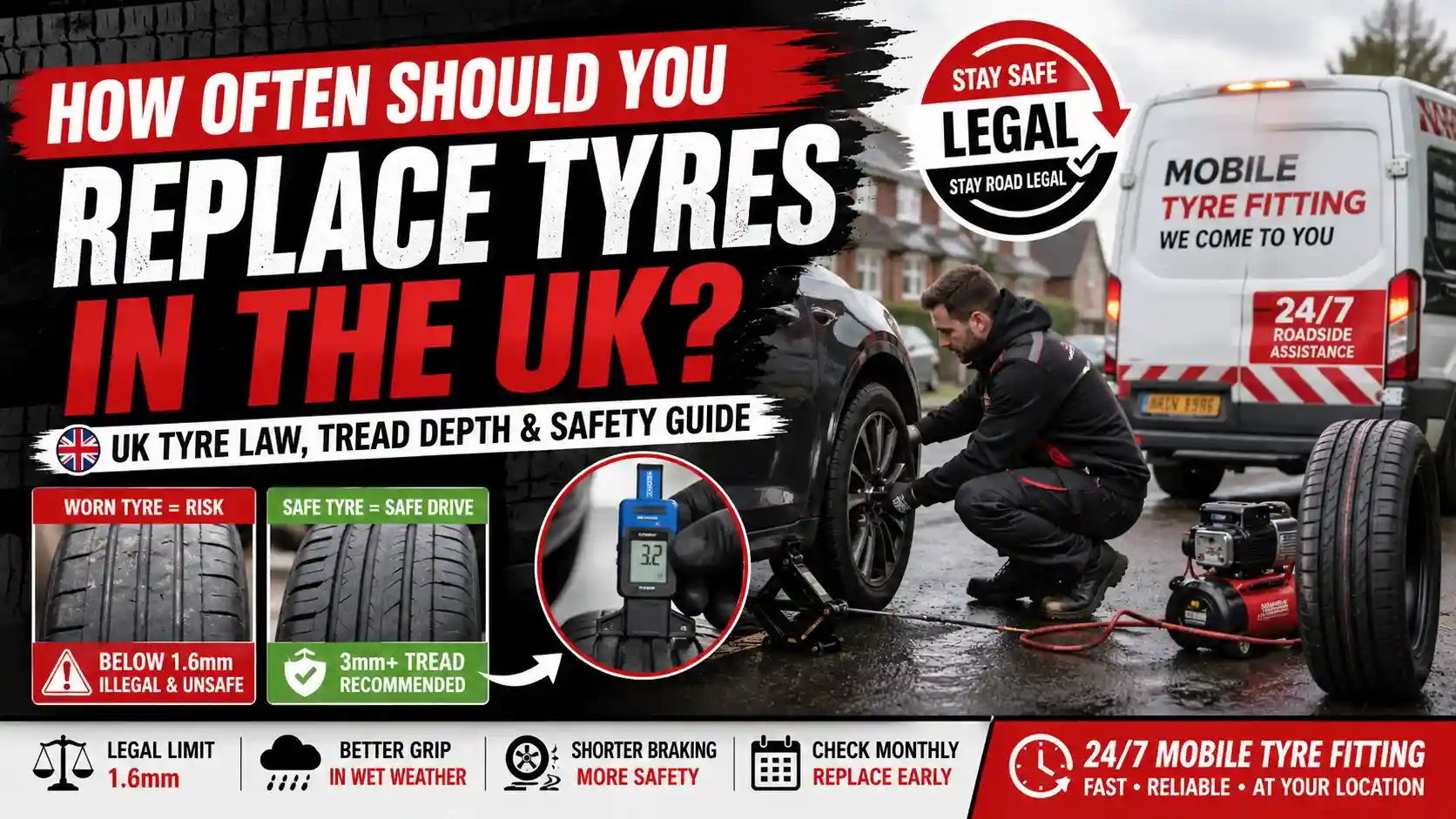
Tyre replacement law in the UK does not set a fixed time interval for changing tyres. Instead, the law focuses on tyre condition, specifically tread depth, damage, and roadworthiness. Every driver in the UK is legally required to maintain tyres that meet minimum safety standards at all times, or face serious penalties.
Your tyres are the only part of your vehicle that touches the road. Everything, braking, steering, and grip in wet weather, depends on them being in legal and safe condition. Understanding the tyre replacement law UK is not just about avoiding fines. It is about staying alive on the road.
This guide explains the law clearly, covers MOT requirements, penalty risks, and tells you exactly when your tyres need replacing.
What Is Tyre Replacement Law in the UK?
UK tyre law requires all vehicles driven on public roads to have tyres that are in a safe, roadworthy condition at all times. There is no specific law that says “replace your tyres every X years”; instead, the law sets minimum standards for tyre condition.
The legal framework comes from the Road Traffic Act and is enforced by the DVSA (Driver and Vehicle Standards Agency). Under these rules, it is a criminal offence to drive a vehicle with tyres that:
- Have a tread depth below the legal minimum of 1.6mm
- Have cuts, bulges, or lumps on the sidewall or tread area
- Are in any condition that makes them unsafe for road use
- Are they the wrong size or type for the vehicle
An illegal tyre is not just a minor issue. It is a prosecutable offence with real financial and legal consequences. If you are unsure whether your tyres are road legal, visiting the tyre repair service is a good starting point for understanding your options.
UK Legal Tyre Tread Depth Rule (1.6mm Explained)
The legal minimum tyre tread depth in the UK is 1.6mm. This must be maintained across the central three-quarters of the tyre, around the full circumference.
Tread depth matters for three critical reasons:
Braking distance: Worn tyres take significantly longer to stop. At 70mph in wet conditions, a tyre with a 1.6mm tread can take up to twice the stopping distance of a tyre with a 3mm tread. That difference can mean the gap between a near-miss and a serious collision.
Aquaplaning prevention: Tyre tread channels water away from the contact patch between your tyre and the road. The deeper the tread, the more water it clears. Shallow tread leads to aquaplaning, where the tyre rides on a film of water and loses grip entirely.
Wet weather grip: The UK receives significant rainfall year-round. Tread depth directly affects how well your vehicle grips in wet conditions. Low tread in UK driving conditions is a serious safety risk, not just a legal issue.
Safe limit vs legal limit: The legal minimum is 1.6mm, but TyreSafe UK, the UK’s leading tyre safety charity, recommends replacing tyres at 3mm. At 1.6mm, braking performance has already deteriorated significantly. Many experienced drivers and tyre professionals treat 3mm as the real replacement point, not 1.6mm.
When Do Tyres Become Illegal in the UK?
A tyre becomes illegal in the UK when its tread depth falls below 1.6mm, or when it shows physical damage that makes it unsafe. Both conditions can result in prosecution.
Specific situations that make a tyre illegal include:
Tread below 1.6mm: Even if the rest of the tyre looks fine, a tread depth below the legal limit makes the tyre illegal to use on UK roads.
Visible damage: Cuts, cracks, bulges, or lumps on the tyre sidewall or tread area are illegal regardless of tread depth. A bulge in a tyre indicates internal structural damage, and the tyre can fail without warning.
Uneven wear: Severe uneven tyre wear can make a tyre illegal even if the average tread depth appears adequate. If one part of the tread is below 1.6mm, the tyre fails the legal test.
Penalty structure for illegal tyres in the UK:
- Up to £2,500 fine per illegal tyre
- 3 penalty points per illegal tyre on your driving licence
- A vehicle with four illegal tyres could result in up to 12 penalty points, enough for a driving ban
- Automatic MOT failure
- Potential insurance claim rejection if an accident occurs while driving on illegal tyres.
If you notice your tyres showing signs that you need tyre replacement, act immediately rather than waiting until an inspection.
How Often Should You Replace Tyres in the UK?
There is no fixed legal interval for replacing tyres in the UK. The law does not say “change tyres every two years” or “after 20,000 miles.” The legal requirement is based on condition, not age or mileage alone.
That said, practical guidance from tyre manufacturers and safety organisations provides useful benchmarks:
Mileage: Most car tyres last between 20,000 and 40,000 miles under normal driving conditions. This varies widely depending on vehicle weight, tyre quality, and driving style.
Time: Even if a tyre has not been driven far, rubber degrades over time. Most tyre manufacturers recommend replacing tyres that are six years old or more, regardless of apparent condition. After ten years, tyres should always be replaced even if they appear fine externally.
Driving conditions: Aggressive driving, sharp braking, fast cornering, and high speeds wear tyres faster. City driving with frequent stops also accelerates wear compared to motorway driving.
Tyre quality: Budget tyres often wear faster than mid-range or premium options. Premium tyres from manufacturers such as Michelin, Bridgestone, Continental, and Goodyear typically last longer and perform better at the legal minimum tread depth.
The practical rule: Do not wait until you reach 1.6mm. Replace tyres when they reach 3mm tread depth. This is the TyreSafe recommendation and gives you a genuine safety margin before the legal limit is reached.
For information on tyre replacement services, including how quickly a new tyre can be fitted at your location, the options are straightforward and fast.
MOT Tyre Requirements in the UK
Your tyres are inspected as part of every MOT test. A tyre below the legal tread depth, or with visible damage, will result in an automatic MOT failure.
During the MOT, the tester checks:
Tread depth: Measured across the central three-quarters of the tyre. Any tyre below 1.6mm fails immediately.
Tyre condition: The tester looks for cuts, bulges, cracks, or exposed cords. Any of these results in failure.
Tyre sidewall damage: Even minor damage to the sidewall can cause a failure if the tester judges it to be unsafe.
Uneven wear: Severe uneven wear patterns can indicate alignment or suspension problems. In serious cases, this causes an MOT failure.
Tyre type and size: Tyres must be the correct size and type for the vehicle. Mismatched tyres, for example, mixing radial and cross-ply, also fail.
Legal compliance vs MOT compliance: Your tyres need to meet the legal standard at all times, not just at MOT time. Driving with illegal tyres between MOT tests is still a criminal offence even if the car passed its last MOT with good tyres.
If your tyres are likely to fail an upcoming MOT, getting them replaced in advance is the right move. Visit our mobile tyre fitting service page to arrange a fast, convenient replacement.
Warning Signs Your Tyres Need Replacement
Replace your tyres immediately if you notice any of the following:
Worn tread pattern: If the tread looks shallow, flat, or the wear indicators (small rubber bars built into the tyre grooves) are level with the tread surface, your tyre is at or near the legal limit.
Cracks in the rubber: Small cracks on the sidewall or between tread blocks indicate the rubber is ageing and breaking down. This is especially common in tyres over five years old.
Bulges or deformation: A bulge on the sidewall is a sign of internal damage. This tyre can fail suddenly and without warning. Replace it immediately.
Vibrations while driving: Unusual vibrations, especially at motorway speeds, can indicate uneven tyre wear or internal damage. Have the tyres checked. Our post on why your car is shaking while driving explains when these points lead to tyre issues.
Poor wet-road grip: If your car takes noticeably longer to stop in wet weather, or if it feels unstable in the rain, your tread depth may be too low for safe wet driving, even if still technically legal.
Uneven wear patterns: Wear only on the edges, or only in the centre of the tread, suggest alignment or inflation problems. The tyre itself may need replacing, and the underlying cause needs addressing too.
How to Check Tyre Tread Depth at Home
You can check your tyre tread depth quickly at home using one of these three methods:
Method 1 – Tread Wear Indicators: All modern tyres have small rubber bars moulded into the tyre grooves. These bars sit at exactly 1.6mm. If the surface of the tread is level with these bars, your tyre is at the legal minimum and must be replaced.
Method 2 – The 20p Coin Test (UK Method): Insert a 20p coin into the main tread groove. If the outer border of the coin (the raised band around the edge) is hidden by the tread, your depth is above 1.6mm. If you can see the full outer border of the coin, your tread is below the legal limit. Replace the tyre immediately.
Method 3 – Tread Depth Gauge: A small tread depth gauge costs a few pounds and gives an accurate reading in millimetres. Insert the probe into the tread groove, press it flat against the tyre, and read the measurement. Check multiple points across the tyre width and around the circumference.
How often to check: Check your tyre tread depth at least once a month and before long journeys. Also, check after any impact with a pothole or kerb. If you notice your tyre pressure warning light has come on, inspect the tyres visually at the same time.
Penalties for Driving with Illegal Tyres in the UK
Driving with illegal tyres in the UK is a serious criminal offence. The penalties are applied per tyre, so multiple illegal tyres multiply the consequences.
The penalty for each illegal tyre is:
- A fine of up to £2,500
- 3 penalty points added to your driving licence
For a vehicle with four illegal tyres, that is a potential fine of £10,000 and 12 penalty points, which triggers an automatic driving ban for most licence holders.
Insurance implications: If you are involved in an accident and your tyres are found to be illegal, your insurance company may refuse to pay out. This leaves you personally liable for all costs, vehicle repairs, third-party claims, and legal fees.
Police roadside checks: Officers can stop any vehicle and check the tyre condition. A roadside check that reveals illegal tyres results in immediate action. The vehicle may be prohibited from driving until legal tyres are fitted.
The fastest way to resolve an illegal tyre situation is to call a mobile tyre fitting service that can come to your location the same day. See our same-day tyre replacement in Bristol page for details on how quickly this can be arranged.
Tyre Age vs Legal Tread Depth
Old tyres can be dangerous even if they still appear to have adequate tread depth. Rubber is a natural material that degrades over time, regardless of use.
As tyres age, the rubber compound hardens and becomes brittle. This reduces grip, increases cracking risk, and makes the tyre more likely to fail under stress even if the tread depth reads above 1.6mm.
Age guidelines:
- 6 years: Most tyre manufacturers recommend a professional inspection at six years, even if the tyre looks fine.
- 10 years: After ten years from the date of manufacture, tyres should always be replaced without exception.
How to find your tyre’s age: Every tyre has a DOT code on the sidewall. The last four digits tell you the week and year of manufacture. For example, “2419” means the tyre was made in week 24 of 2019.
Storage and environment: Tyres stored in direct sunlight, extreme heat, or exposed to ozone (such as near electric motors) degrade faster. Even unused spare tyres age and should be checked if they are more than six years old.
If you have older tyres on your vehicle and are unsure of their condition, our guide on the signs you need tyre replacement will help you assess them correctly.
Why Early Tyre Replacement Improves Safety and Saves Money
Replacing tyres before they reach the legal limit is always the smarter financial and safety decision.
Here is why replacing early makes sense:
Shorter braking distances: A tyre with a 3mm tread stops noticeably shorter than one with a 1.6mm tread. In an emergency stop situation, that extra braking performance could prevent a collision entirely.
Better wet weather grip: The UK’s wet roads demand tyres with good tread depth. Replacing at 3mm instead of 1.6mm keeps your wet grip performance at a safe level throughout the life of the tyre.
Fuel efficiency: Worn tyres create more rolling resistance, which increases fuel consumption. A new tyre can slightly improve your fuel economy, a real saving over thousands of miles.
Avoiding penalty costs: A tyre replacement costs a fraction of a £2,500 fine per tyre. Proactive replacement is always the cheaper option.
Preventing further damage: Worn or damaged tyres can cause handling problems that stress other vehicle components, such as wheel bearings, suspension, and steering systems. Early replacement protects the rest of your vehicle.
Professional Mobile Tyre Replacement Service
Getting your tyres replaced does not have to mean a trip to a garage. A professional mobile tyre fitting service brings everything to your location, whether you are at home, at work, or stuck on the roadside.
Mobile tyre replacement is the fastest and most convenient way to stay road legal and safe. There is no towing, no waiting room, and no disruption to your day. A trained technician arrives, carries out a full tyre safety inspection, fits the correct replacement tyre, and leaves you roadworthy.
This is especially useful when:
- You discover an illegal tyre and cannot safely drive to a garage
- Your tyre fails suddenly on the road
- You need a same-day replacement before an MOT test
- You want to replace worn tyres without the hassle of a garage visit
For drivers across the UK, and particularly across Bristol, Fast Grip Mobile Tyres provides fast, professional tyre replacement at your location exactly when you need it. Explore the full tyre replacement service for more details, or browse the complete service range to see everything available.
Final Verdict
Fast Grip Mobile Tyres provides 24/7 mobile tyre fitting across Bristol and surrounding areas, with fast roadside response whenever you need it. Whether you need an urgent replacement to stay road legal or a planned tyre change at home, expert help is just one call away.
Visit the Fast Grip Mobile Tyres to book now, or explore the full blog for more tyre safety guides, tips, and advice.
Frequently Asked Questions
1. What is the tyre replacement law in the UK?
UK tyre law does not set a fixed replacement schedule. Instead, it requires all vehicle tyres to meet minimum condition standards including a tread depth of at least 1.6mm and no visible damage. Driving with illegal tyres is a criminal offence under the Road Traffic Act.
2. What is the legal tyre tread depth in the UK?
The legal minimum tyre tread depth in the UK is 1.6mm, measured across the central three-quarters of the tyre, around the full circumference. Most safety organisations recommend replacing at 3mm for genuine road safety.
3. How often should tyres be replaced in the UK?
There is no fixed legal interval. Most tyres last 20,000 to 40,000 miles or three to six years under normal conditions. Tyres over six years old should be professionally inspected, and those over ten years old should always be replaced regardless of tread depth.
4. Can you drive with a 2mm tyre tread in the UK?
Technically, yes, 2mm is above the 1.6mm legal minimum. However, tyre safety organisations recommend replacing at 3mm, as braking performance at 2mm in wet conditions is significantly reduced. Driving at 2mm is legal but not considered safe practice.
5. Do tyres fail MOT if the tread is low?
Yes. Any tyre below 1.6mm tread depth causes an automatic MOT failure. Visible damage, including bulges, cuts, or exposed cords, also fails regardless of tread depth.
6. What happens if tyres are illegal in the UK?
Each illegal tyre carries a fine of up to £2,500 and 3 penalty points. Four illegal tyres could result in a £10,000 fine and 12 penalty points, enough for a driving ban. Insurance may also refuse claims if illegal tyres are involved in an accident.
7. How do I check if my tyres are legal?
Use the 20p coin test: insert a 20p coin into the main tread groove. If the outer rim of the coin is hidden, your tread is above 1.6mm. If the rim is visible, replace the tyre immediately. A tread depth gauge gives a more accurate measurement.
8. Is it illegal to drive with worn tyres in the UK?
Yes. Driving with tyres below 1.6mm tread depth, or with tyres that have visible damage such as bulges or cuts, is a criminal offence in the UK under the Road Traffic Act.
9. How long do tyres last on average in the UK?
Most car tyres last between 20,000 and 40,000 miles, or three to six years. Driving style, road conditions, vehicle weight, and tyre quality all affect lifespan significantly.
10. Can police check tyre tread depth at the roadside?
Yes. Police officers can stop any vehicle and inspect the tyre condition during a roadside check. They use tread depth gauges and visual inspection. Finding illegal tyres at the roadside results in immediate action and may prevent the vehicle from being driven further.
11. What is the safest tyre tread depth?
TyreSafe UK recommends 3mm as the practical replacement threshold. At 3mm, braking performance in wet conditions is still at a good level. Waiting until 1.6mm means braking distances are already significantly longer than with newer tyres.
12. Are old tyres illegal even with good tread depth?
Not automatically, but tyres over ten years old are considered unsafe by most tyre manufacturers and should be replaced regardless of tread depth. The rubber degrades with age even without use, reducing grip and increasing the risk of sudden failure.
13. What causes tyres to wear quickly?
Common causes include under-inflation, over-inflation, aggressive braking, sharp cornering, poor wheel alignment, and worn suspension components. Regular tyre pressure checks and alignment inspections help extend tyre life.
14. When should I replace tyres before an MOT?
If your tread depth is approaching 2mm or you can see any visible damage, replace the tyres before the MOT rather than risk a failure. Getting a same-day replacement fitted quickly is easy with a mobile service.
15. Can uneven tyre wear cause an MOT failure?
Yes. Severe uneven wear can result in an MOT failure if any part of the tyre tread falls below 1.6mm, or if the wear pattern suggests an underlying safety issue with alignment or suspension.