
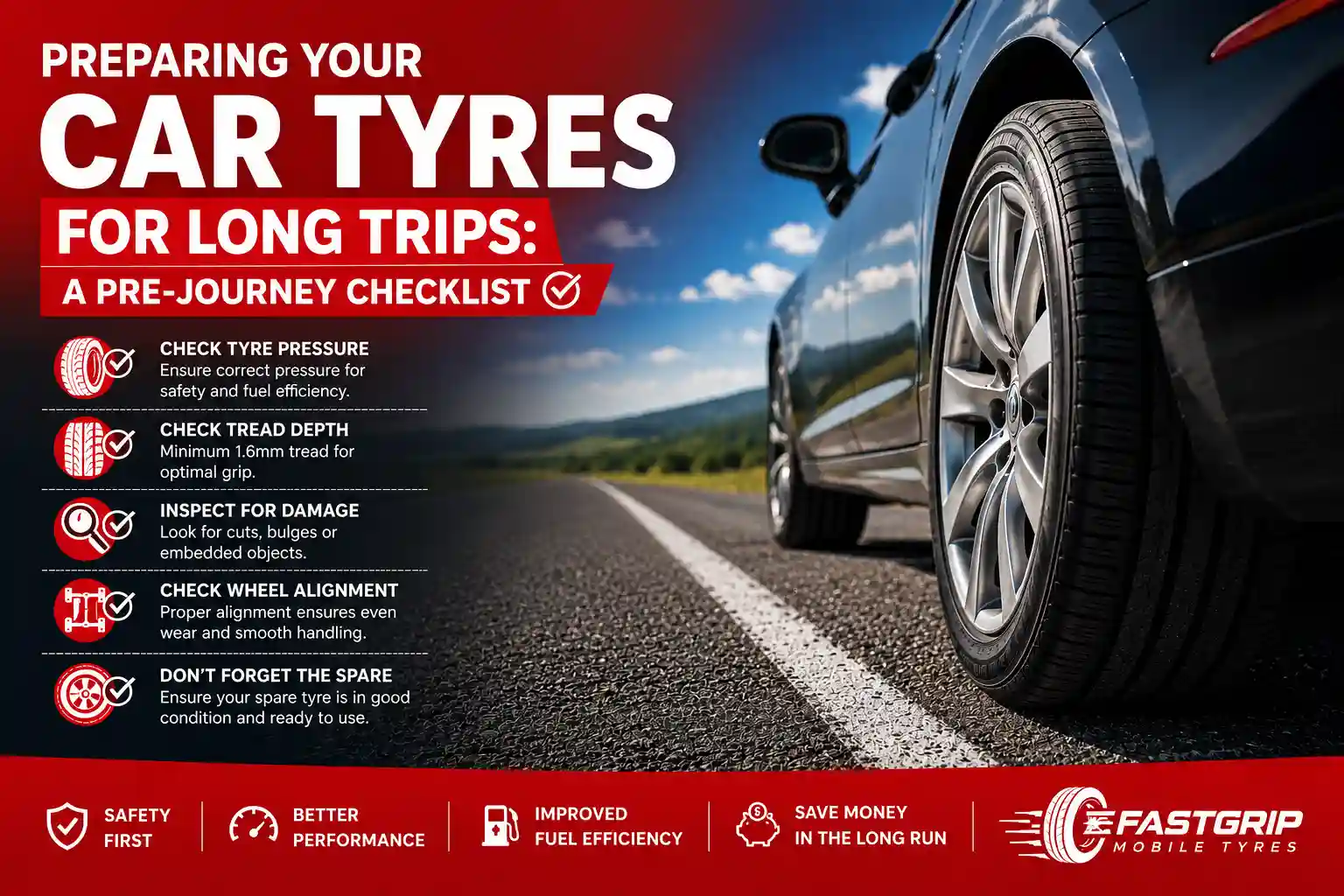
Your tyres are the only part of your car that actually touch the road, yet they’re usually the last thing anyone thinks about before a long drive. Before you worry about playlists, snacks, or which route to take, your tyres deserve five minutes of proper attention. A quick pre-journey check can prevent a blowout, cut your fuel costs, and turn a stressful drive into a smooth one — whether you’re heading from Bristol to Cornwall for the weekend or driving up to Scotland for a family visit.
Key Takeaways
- Tyre pressure, tread depth above 3mm, and damage-free sidewalls are the three fastest checks that cut blowout risk on long journeys.
- Wheel alignment and balancing should be checked before a long trip, not just when something feels wrong – misalignment quietly wears tyres unevenly and increases blowout risk under load.
- Driving on illegal tyres in the UK can cost you £2,500 and 3 penalty points per tyre – up to £10,000 and 12 points for a full set.
- A roof box or fully loaded boot changes your ideal tyre pressure – most drivers get this wrong and don’t realise it.
- Checking your tyres again after a long trip is just as important as checking them before – motorway miles and hot tarmac take a toll that isn’t always visible straight away.
- Bristol drivers can book a mobile tyre fitting Bristol appointment for a pre-trip inspection, replacement, or emergency roadside help – 24/7, no garage visit needed.
Why Tyre Preparation Matters Before a Long Trip
Picture setting off from Bristol to Devon on a bank holiday weekend — car packed with luggage, kids in the back, and a roof box strapped on top. Or a late-night drive up the M5 to catch an early ferry. These are exactly the conditions where tyres are put under the most stress: heavy loads, sustained high speeds, and hot tarmac all add pressure to every part of the rubber.
Your tyres directly affect how quickly you stop, how much grip you have in the rain, and how much fuel you burn. Wet-weather stopping distances from 70mph can increase by more than 8 metres once tread depth drops from around 3mm to the legal limit of 1.6mm — and that gap is often the difference between stopping safely and a collision.
Most tyre-related breakdowns on long journeys could have been avoided with a proper check a day or two before setting off. Fast Grip Mobile Tyres can carry out that check at your home or workplace in Bristol, so problems get caught before you’re stuck on the hard shoulder.
Check Tyre Condition and Tread Depth
Start with a full visual inspection – including the spare. Walk around the car and look closely at each tyre for:
- Cuts, gashes or gouges in the sidewall
- Bulges or blistering (a sign of internal damage)
- Cracking or dry rot along the sidewall
- Embedded objects like nails, screws or glass
- Exposed cords or steel belts
Many of these issues get missed during a routine MOT unless they’re severe, so it’s worth checking yourself before a long trip.
For tread depth, use the 20p test – insert a 20p coin into the main grooves, and if the outer band is visible, your tread is close to the legal limit. A tread depth gauge gives a more accurate reading. While 1.6mm is the legal minimum, it’s safer to replace tyres once they drop below 3mm, since wet-weather grip falls off sharply after that point.
Uneven wear on the inner or outer edge of a tyre often points to an alignment issue – which brings us to a step most drivers skip entirely.
Wheel Alignment and Balancing — The Step Most Drivers Skip
This is one of the most overlooked parts of trip preparation. Misaligned wheels don’t just cause uneven tyre wear over time — under a fully loaded car at motorway speed, they can pull your steering to one side, increase tyre heat, and raise your blowout risk on exactly the kind of journey where you can least afford it.
Signs your alignment may be off:
- The car pulls slightly left or right when driving straight
- The steering wheel isn’t centred when driving straight
- One side of the tread wears faster than the other
- Vibration through the steering wheel at speed (often a balancing issue rather than alignment)
If you’ve recently hit a pothole, kerbed a wheel, or you’re planning a long motorway-heavy trip, it’s worth having alignment and balancing checked beforehand rather than after something starts to feel wrong.
Not sure what to look for? Our guide on signs you need tyre replacement breaks down every warning sign in detail.
Set the Correct Tyre Pressure for a Long Journey
Tyre pressure needs to match your load, not just your daily commute. This matters more than most drivers realise — around 80% of tyre blowouts are caused by underinflation.
Find your recommended pressure on:
- The sticker on the driver’s door pillar or fuel filler flap
- Your vehicle’s owner’s manual
Most vehicles list both a standard pressure and a “fully laden” pressure. If you’re carrying passengers, luggage, and especially a roof box, use the fully laden figure — typically 0.2 to 0.3 bar (roughly 2–4 PSI) higher than standard.
Always check pressure when tyres are cold, ideally before you’ve driven anywhere that day. A digital gauge is more reliable than most petrol station airlines. Check all four tyres plus the spare.
Underinflation increases sidewall flex, heat build-up, blowout risk, and fuel consumption.
Overinflation reduces your contact patch, increases braking distance, and gives a harsher ride with less wet-weather grip.
The Roof Box Effect – Why Your Pressure Guide Isn’t Enough on Its Own
A roof box changes more than your car’s silhouette. It raises your centre of gravity, increases wind resistance, and adds weight sitting well above the axle — all of which puts extra strain on your tyres, particularly the rears, during cornering and braking. Most manufacturer pressure charts assume weight distributed inside the car or boot, not stacked on the roof.
If you’re running a roof box on a long trip:
- Use the fully laden pressure setting as your minimum, not your default
- Reduce your motorway cruising speed slightly — roof boxes significantly increase wind drag and heat build-up in the tyres at speed
- Recheck pressure once you’ve loaded the car fully, not before
Match Your Tyres to Season and Journey Type
UK weather rarely cooperates with travel plans. A summer trip can bring sudden downpours, while a December drive into Wales or the Peak District can mean ice on higher routes even outside the depths of winter.
| Tyre Type | Best For | Not Ideal For |
|---|---|---|
| Summer | Warm dry/wet roads above ~7°C | Snow, ice, freezing temps |
| Winter | Cold weather, ice, snow | Hot summer tarmac |
| All-Season | Mixed conditions year-round | Extreme heat or heavy snow |
If your route heads into hill country or further north during colder months, winter or all-season tyres are worth considering.
Check the DOT date code on your tyres — a four-digit number (e.g. 1523 means week 15 of 2023). Even tyres with good tread degrade with age. Most manufacturers recommend replacement by 5–6 years, with a hard limit of 10 years regardless of tread remaining — especially before a demanding long-distance trip.
What UK Law Actually Says About Tyre Condition
Most drivers know 1.6mm is the legal tread limit, but far fewer know what happens if they don’t meet it. Driving on illegal tyres in the UK can result in:
- £2,500 fine and 3 penalty points — per tyre
- Up to £10,000 and 12 points if all four tyres are non-compliant
- An automatic MOT failure
- Points that stay on your licence for 4 years and can raise your insurance premium
The law also requires tyres to be free of cuts, bulges, and exposed cords, and to be correctly rated for your vehicle’s load and speed requirements. This applies to your spare too, if it’s a full-size spare in use on the road.
Given the size of the fine, replacing a borderline tyre before a long trip is far cheaper than risking it.
Prepare for Punctures and Tyre Emergencies
Even well-maintained tyres can be damaged by debris or potholes. Before you set off, check:
- Spare wheel or space-saver – condition, age, and inflation
- Jack and wheel brace – present and compatible with your car
- Locking wheel nut key
- Tyre repair kit or sealant bottle, if your car doesn’t carry a spare
Pack these in an easily accessible part of the boot:
- Portable air compressor
- Reflective warning triangle
- High-visibility vest
- Torch with fresh batteries
- Basic gloves
There are situations where you shouldn’t attempt a roadside wheel change yourself — narrow hard shoulders, poor visibility, heavy rain, or travelling with children or elderly passengers. In these cases, calling a mobile tyre service is safer and often faster than a DIY fix.
Support Tyres With Essential Vehicle Checks
Tyres don’t work in isolation — a few other checks reduce the chance of a preventable breakdown.
Fluid levels: Engine oil, coolant, brake fluid, power steering fluid, and screen wash – all should sit between the minimum and maximum marks.
Lights: Headlights, brake lights, indicators, fog lights and number plate bulbs should all be working, especially for driving through dusk or changing weather.
Brakes: Listen for grinding or squealing, and feel for any pulling to one side.
Battery: Cars that mostly do short trips around Bristol often have a weaker battery than expected. A long drive with headlights, air conditioning, and phone chargers running puts real strain on a tired battery.
Driving Habits That Protect Your Tyres Mid-Journey
- Gentle acceleration and steady speeds reduce heat build-up – cruise control helps maintain a constant tyre temperature.
- Leave extra following distance in wet weather, even with good tread – aquaplaning risk rises sharply with speed.
- Take a break every two to three hours. This helps driver fatigue and gives your tyres and brakes time to cool.
- Avoid kerbing wheels when parking at unfamiliar service stations – sidewall damage from a sharp kerb often shows up as a slow puncture days later.
What to Pack Alongside Your Tyre Essentials
- First aid kit – kept in the cabin, not buried under luggage
- Water and snacks
- Blankets, especially for winter or overnight trips
- Phone charger and a paper map as backup
- Wet wipes
Distribute weight evenly and keep heavy items low and central – this helps both stability and tyre wear. Check your car’s maximum payload before loading up, and secure loose items so they can’t become a hazard under sudden braking.
After the Trip: Don’t Skip the Return Check
It’s easy to forget your tyres the moment you’re home, but a long trip — especially one with a heavy load, motorway miles, and hot tarmac — puts real wear on them. Once you’re back:
- Recheck tread depth and look for any new damage picked up en route
- Reset tyre pressure back to your normal daily setting once the load is removed
- Check for any slow punctures that may have started during the trip but weren’t obvious at the time
A five-minute check now can catch a problem while it’s still simple to fix, rather than finding out on your next drive.
When to Call a Professional Before or During Your Trip
Some issues aren’t DIY jobs. Delay your journey and get tyres checked if you notice:
- Two or more tyres near the legal tread limit
- Visible bulges or exposed cords
- Steering pulling strongly to one side
- Vibration through the wheel at speed
This is exactly where mobile fitting helps — a technician comes to your driveway the night before you travel, so you’re not losing hours at a garage.
Fast Grip Mobile Tyres offers transparent pricing with no hidden callout fees, 24/7 across Bristol. Whether it’s a pre-trip check before an early ferry, a late-night emergency on the M32, or a puncture the morning you’re due to leave, our team comes to you with the tyres, tools, and equipment to get you back on the road. Call +44 7833122296 or book online for tyre checks, replacements, or emergency help – at home, at work, or at the roadside.