
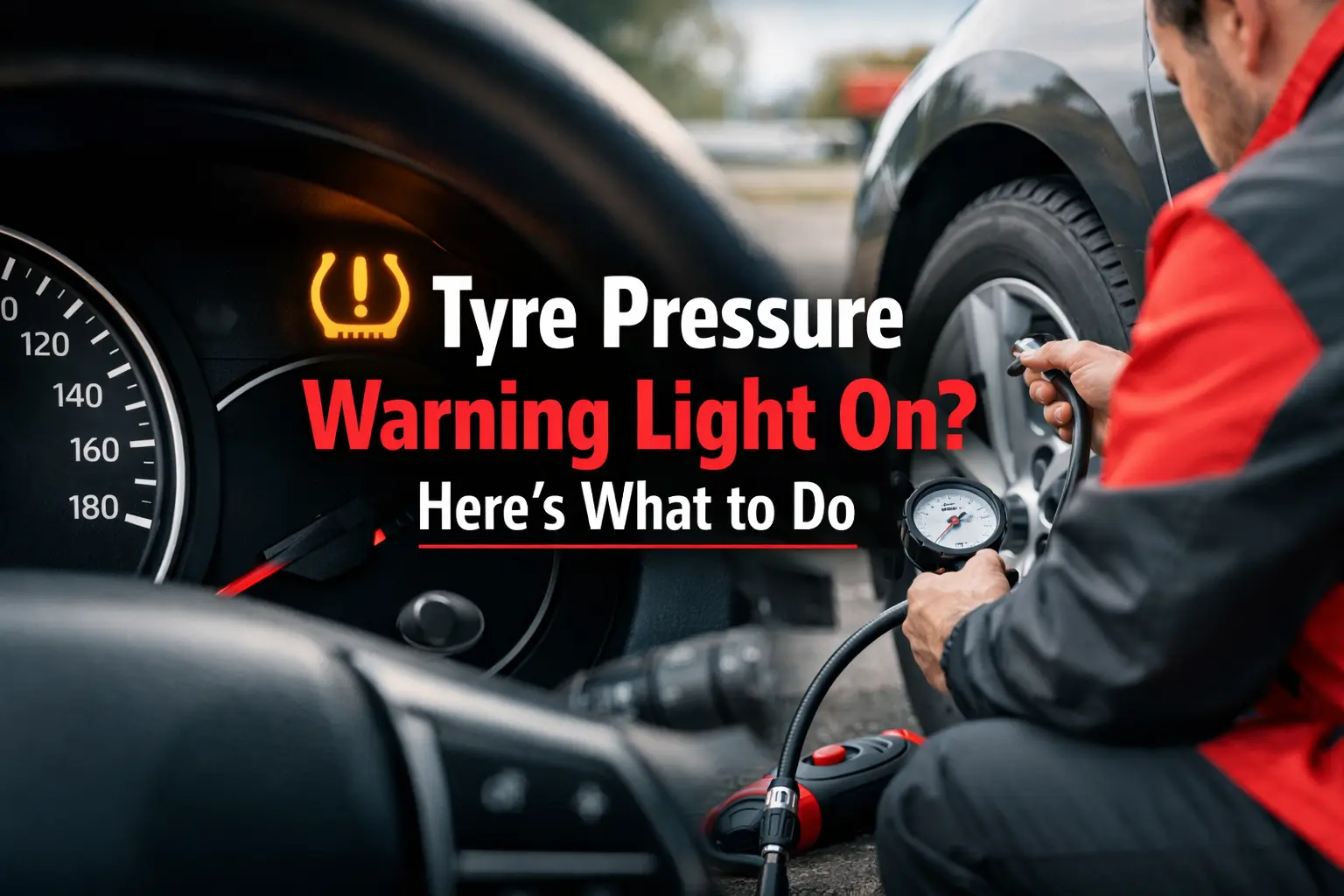
The tyre pressure warning light is that amber horseshoe-shaped icon with an exclamation mark that suddenly lights up on your dashboard. Sound familiar? You are not alone. Underinflated tyres are among the most common and easily preventable causes of serious road incidents in the UK, yet thousands of drivers ignore the warning every day.
When the TPMS light comes on, check all four tyres with a pressure gauge, inflate them to the recommended PSI (printed on your door jamb sticker), then reset the system. If the light stays on, you likely have a slow puncture or a TPMS sensor fault that needs professional attention.
Whether it is your first time seeing this light or the third, this guide will tell you exactly what to do and why.
What Is the Tyre Pressure Warning Light?
The Tyre Pressure Monitoring System (TPMS) is a built-in safety feature on every new passenger car sold in the UK since November 2014, as required by the EU Tyre Pressure Monitoring System Directive. Its job is simple: it monitors your tyre pressures and warns you when they drop too low.
What Does the Icon Look Like?
The icon looks like a cross-section of a tyre, a flat-bottomed horseshoe shape with an exclamation mark in the middle. It glows in amber or yellow. Some drivers describe it as a fishbowl with an “!” inside. Here is what the different states mean:
Light Behaviour | What It Means | Action Needed |
Solid amber | One or more tyres are 25%+ below recommended pressure | Check and inflate tyres now |
Flashes for 60–90 seconds, then stays on | TPMS system malfunction or sensor fault | Visit a technician |
Comes on only in the morning | Cold overnight air reduced pressure | Check cold tyre pressure before driving |
Comes on after a tyre change | System not recalibrated after new tyres fitted | Reset the TPMS |
Direct TPMS vs Indirect TPMS — What Is the Difference?
Not all systems work the same way. There are two types, and knowing which one your car has affects how you reset it.
Feature | Direct TPMS | Indirect TPMS |
How it works | Pressure sensor inside each wheel | Uses ABS wheel speed sensors |
Accuracy | Shows exact PSI per tyre | Detects rotation speed differences |
Sensor battery life | 5–10 years | No separate battery needed |
Reset method | Button or infotainment system | Drive cycle auto-learn |
Common in | Most cars post-2014 | Older vehicles, BMW, some VW |
One important legal point worth knowing: since January 2012, a TPMS fault light is an automatic MOT failure for applicable vehicles. It is not something you can ignore and hope goes away.
Is It Safe to Drive With the Tyre Pressure Warning Light On?
Short answer: no, not really. But life is not always that simple. If you are in moving traffic or far from a safe stop, here is what you need to know.
Driving on underinflated tyres adds up to 8 metres to your stopping distance at 70mph roughly the length of two cars. That matters enormously in an emergency. On top of that, softer tyres cannot channel water away from the road surface as effectively, which increases aquaplaning risk in wet conditions. And the further you drive, the greater the chance of a sudden tyre blowout.
If You Must Keep Driving, Do This
- Reduce your speed to a maximum of 50mph immediately
- Avoid motorways like the M4, M5, and M32 around Bristol if at all possible
- No harsh braking, sharp cornering, or sudden acceleration
- Plan to stop within 10 miles for a proper check
- Do a quick visual scan look for any tyre sitting noticeably low, objects in the tread, or sidewall bulges
Stop Immediately If You Notice Any of These
- Visible sidewall bulge, this signals structural damage and the tyre could fail at any moment
- The tyre looks completely flat or you can hear a flapping, rhythmic sound
- The car is pulling hard to one side when driving straight
- There is a steering wheel vibration you did not notice before
Here is a real example of why this matters. A Bristol driver once continued three miles on a slow puncture on the A38, assuming it would hold a bit longer. By the time he pulled over, the tyre had separated from the rim. What could have been a £90 puncture repair turned into a £350 tyre replacement, and he was lucky it did not blow at speed. Check the pressure, always.
7 Common Reasons Your Tyre Pressure Warning Light Comes On
The light does not always mean a puncture. Here are the seven most common causes, from the everyday to the less obvious.
1. Simply Low Tyre Pressure
Tyres naturally lose around 1–3 PSI per month through normal use. If you have not checked your pressures in a while, this is almost certainly the most likely reason. A quick top-up and reset will usually clear it.
2. Cold Weather and Temperature Drops
This is a big one in the UK. For every 10°F (5.5°C) drop in temperature, a tyre loses approximately 1 PSI. In Bristol, where temperatures swing from a warm 25°C summer afternoon to a 3°C winter morning, your tyre pressure can drop 4–5 PSI between seasons without a single nail in sight. Check pressures every autumn when the temperature starts to fall.
3. Slow Puncture
A slow puncture is trickier because you might not even notice it at first. A small nail or screw embedded in the tread, a Schrader valve leak (the small metal valve stem on your wheel rim), or a bead leak caused by rim corrosion can all cause gradual pressure loss over hours or even days. If you inflate the tyre and the warning light returns within 24 hours, a slow puncture is almost certainly the cause. Our guide on signs you need tyre replacement covers when a repair is sufficient and when you need a new tyre entirely.
4. TPMS Sensor Fault
The TPMS sensor is a small battery-powered device mounted inside the wheel. Its battery typically lasts 5–10 years. When the battery fails or the sensor is physically damaged by a pothole or curb strike it can trigger the warning light even if the actual tyre pressure is perfectly fine. A flashing TPMS light, rather than a solid one, usually points to this type of sensor fault rather than a pressure issue.
5. Tyre Rotation or Recent Tyre Change
If you have just had new tyres fitted or your tyres rotated, the TPMS system may not have been recalibrated. Tyre rotation moves sensors to different axle positions, and indirect systems, especially, can stay confused until they complete a drive cycle auto-learn on the road.
6. Low Spare Tyre Pressure
A lot of drivers forget that the spare tyre is also monitored. A space-saver spare that has been sitting untouched in the boot for two or three years can easily trigger the warning. Check it as part of your monthly routine; most spare tyres need to be kept at a higher pressure than your regular tyres.
7. Battery Disconnect or Calibration Error
If your car battery has recently been replaced or disconnected, the ECU (Electronic Control Unit) can lose its TPMS calibration and throw up a warning even though nothing is physically wrong. A simple reset usually resolves this in minutes.
What to Do When the Tyre Pressure Warning Light Comes On (5 Steps)
Step 1: Find a Safe Place to Stop
Do not panic. Indicate early and pull over smoothly. On a motorway, follow Highways England guidance and use an emergency refuge area or the hard shoulder. In Bristol’s city streets, aim for a petrol station forecourt, car park, or lay-by away from moving traffic.
Step 2: Do a 30-Second Visual Inspection
Walk around the car and check for:
- Objects embedded in the tread (nails, screws, glass fragments)
- Any tyre that looks visibly flatter than the others
- Sidewall damage cuts, bulges, or deep scuffs
- A damaged or missing valve cap on any wheel
Step 3: Check Pressure With a Gauge
Use a digital tyre pressure gauge for an accurate reading. They cost around £10–20 and are well worth keeping in the glovebox. Always measure cold tyre pressure: before driving more than 1 mile, or after the car has been stationary for at least 3 hours. Heat from driving temporarily increases the pressure reading and makes results unreliable.
Where to find your car’s recommended tyre pressure:
- The driver’s door jamb sticker the most common location, on the edge of the door frame
- Inside the fuel filler flap
- In the owner’s manual under the ‘Tyres’ section
Here are typical pressure ranges as a general reference:
Vehicle Type | Typical Front PSI | Typical Rear PSI |
Small city car (e.g. Fiesta, Polo) | 30–32 PSI | 30–32 PSI |
Family car (e.g. Focus, Golf) | 32–35 PSI | 32–35 PSI |
SUV or crossover (e.g. Qashqai, CR-V) | 35–38 PSI | 36–40 PSI |
Van or light commercial vehicle | 50–65 PSI | 65–80 PSI |
Any vehicle when fully loaded | +3–5 PSI | +3–5 PSI |
Always use the figure specific to your car from the door jamb sticker these are general guidelines only.
Step 4: Inflate to the Correct Pressure
Your options, ranked best to least ideal:
- Garage airline pump usually free, accurate, and fast. Best option.
- A foot pump with a built-in gauge is reliable if you carry one in the boot
- A 12V electric compressor is convenient, but always cross-check accuracy with a separate gauge
- Emergency tyre sealant kit: temporary fix only. Important warning: sealant can permanently damage the TPMS sensor, so use it only in a genuine roadside emergency when no other option is available
Step 5: Reset the TPMS System
Inflating the tyres alone will not always turn the light off. The system needs to be reset separately see the full reset guide below.
How to Reset the Tyre Pressure Warning Light
Method 1: TPMS Reset Button (Most Common)
Many cars have a small TPMS reset button located under the steering wheel, near the OBD port, or in the glovebox. Here is the procedure:
- Make sure all tyres are inflated to the correct pressure
- Turn the ignition to ON (without starting the engine)
- Hold the reset button for 3–5 seconds until the warning light blinks three times
- Release the button and start the car
- Drive for 10–20 minutes at various speeds to let the system recalibrate
Method 2: Via the Infotainment System
Modern cars often handle the reset through the dashboard menu. Here is where to find it by brand:
Car Brand | Navigation Path |
VW / Audi / SEAT / Skoda | Vehicle → Settings → TPMS → Store |
BMW | Vehicle Status → Tyre Pressure → Reset |
Mercedes | Service → Tyre Pressure → Confirm |
Ford | Settings → Vehicle → Tyre Monitor → Hold OK |
Vauxhall / Opel | Vehicle Info → Tyre Pressure → Reset |
Toyota | MENU → Vehicle Settings → TPMS → Reset |
Honda | Home → Settings → Vehicle → TPMS Calibration |
Method 3: Drive Cycle (Indirect TPMS)
For cars with indirect TPMS, there is no button to press. Inflate all tyres to the correct pressure, then drive normally for around 10–30 minutes at mixed speeds. The system auto-learns the new baseline, and the light should turn off on its own.
When the Light Still Will Not Go Off
If the light persists after inflating and resetting, or if it is flashing rather than solid, that points to a slow puncture or a faulty sensor. This is the point to call a professional rather than keep guessing.
DIY Fix vs Professional Help
Situation | Fix It Yourself? | Call a Pro? |
Light on due to cold weather just needs inflation | Yes ✓ | Not needed |
The light on after tyre rotation just needs resetting | Yes ✓ | Not needed |
Slow puncture with a nail in the tread | Sometimes (with a repair kit) | Recommended |
Sidewall damage or bulge | No ✗ | Yes, tyre replacement is needed |
TPMS sensor fault (flashing light) | No ✗ | Yes, specialist equipment is needed |
Flat tyre on the motorway | No ✗ | Yes safety risk |
How to Prevent the Tyre Pressure Warning Light From Coming On
A little regular attention prevents most TPMS alerts before they happen.
Monthly checks to build into your routine:
- Check all four tyre pressures before driving (cold reading), once a month
- Check the spare tyre at the same time, it is the one most people forget until they need it
- Look for any objects embedded in the tread during your walk-around
- Make sure all valve caps are fitted; they protect the Schrader valve from dirt, moisture, and corrosion
Seasonal adjustments: In autumn and winter, expect pressures to drop 3–5 PSI and check weekly during cold snaps. In summer, be aware that heat increases internal pressure but do not deflate to compensate, as summer tyre blowouts are more likely when tyres are underinflated and running hot.
Useful tools to keep in the car:
- A digital tyre pressure gauge (£10–20) is far more accurate than forecourt machines
- Mini 12V air compressor (£15–30) handy for topping up without finding a garage
- Tread depth gauge (£3–8) because tyre tread depth and tyre pressure work together when it comes to grip and safety
Conclusion
The tyre pressure warning light is your car trying to tell you something, and it is almost always worth listening to straight away. In most cases, the fix is simple: check your pressures, inflate to the recommended cold tyre pressure from your door jamb sticker, and reset the TPMS. A £10 digital gauge and a two-minute monthly check will prevent most of these alerts from ever happening. But when the light keeps coming back, starts flashing, or you are already stuck at the roadside, that is when you need fast, professional help, not guesswork.
Tyre pressure light still on? Do not risk it. Contact Fast Grip Mobile Tyres now for 24/7 emergency mobile tyre fitting Bristol.
Frequently Asked Questions
1. Can I drive with the tyre pressure warning light on?
Only short distances at reduced speed. Keep under 50mph, avoid motorways, and check pressures within 10 miles. Never drive if a tyre is visibly flat.
2. How much does it cost to fix a TPMS sensor?
£50-150 per sensor plus £20-40 for programming. Mobile fitting includes diagnosis, supply, fitting, and programming in one visit.
3. Why does my tyre pressure light come on in cold weather?
For every 10°F temperature drop, tyres lose 1 PSI. Cold mornings can trigger the light even if the pressures were fine the day before.
4. Can a car fail an MOT with the tyre pressure light on?
Yes, for cars registered from 1 January 2012. A flashing or constant TPMS fault is an automatic MOT failure.
5. What’s the difference between TPMS and a tyre pressure gauge?
TPMS is an electronic warning system. A tyre pressure gauge is a manual tool for accurate measurement. Use both TPMS for alerts, gauge for precision.