
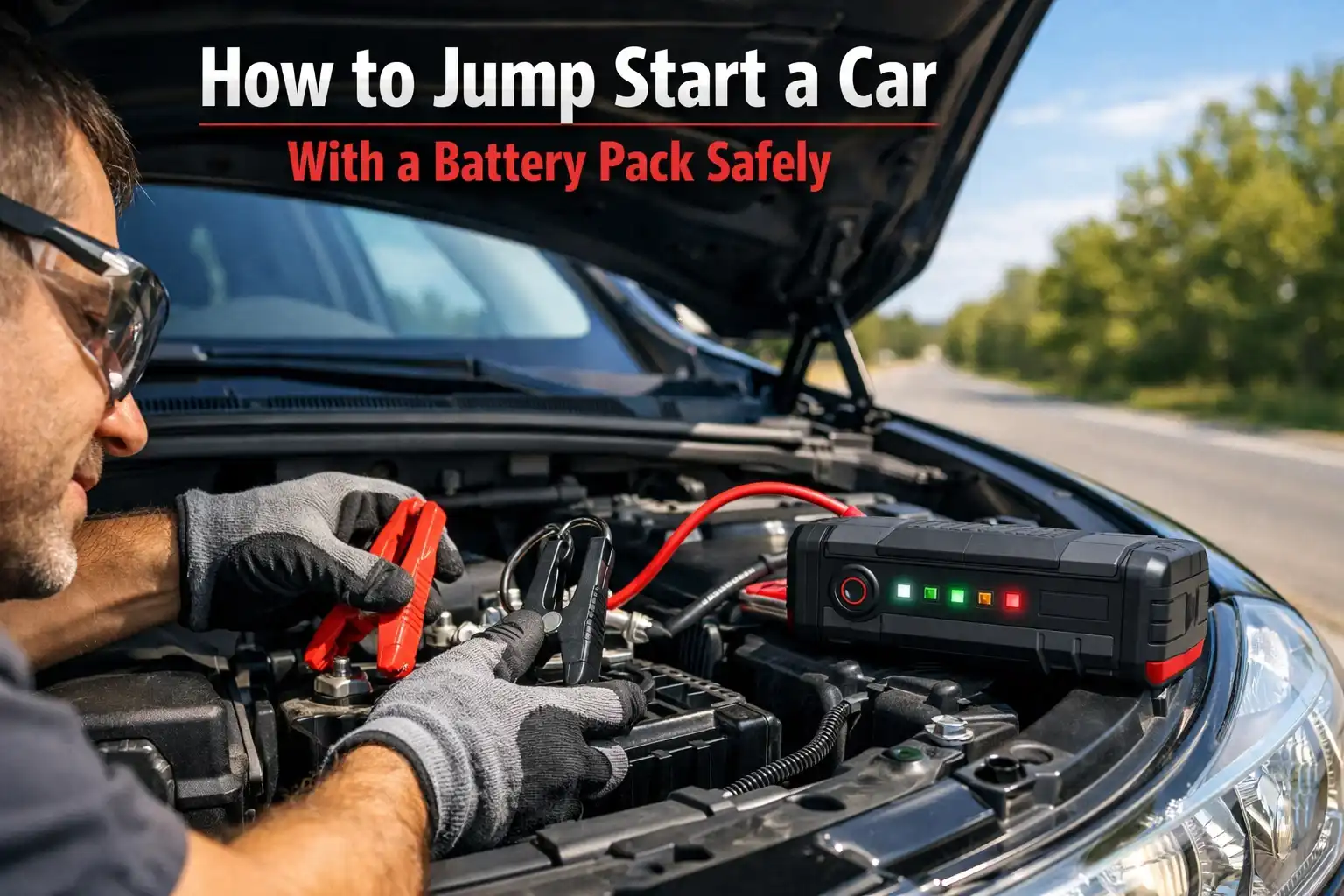
You’re running late, hop into your car, turn the key, and nothing. A dead car battery can strike anyone at any time, leaving you stranded and stressed. The good news is that with a portable car jump starter, you can quickly and safely jump-start your car with a battery pack, all by yourself, using any other vehicle. Whether you left the headlights on overnight, the battery failed in the cold, or it has simply reached the end of its life, having this skill can save you time and frustration. A battery pack provides a fast, solo roadside solution, giving you confidence to handle emergencies efficiently.
In this blog post, we will cover how to jump-start a Car With a Battery Pack, proper clamp connections, and essential safety tips. We’ll also cover troubleshooting advice and maintenance tricks to keep your jump starter ready whenever you need it.
What Is a Battery Pack for Cars?
A battery pack for cars, also called a battery booster pack or portable battery booster, is a compact, rechargeable device designed to deliver a powerful burst of electricity to your flat car battery. Think of it as a superhero sidekick that brings your car back to life when the battery dies.
How Does It Work?
When your car battery loses its charge, it can’t provide enough power to crank the engine. A car jump starter battery pack stores electrical energy and transfers it directly to your battery through special cables and clamps. This gives your car the jolt it needs to start, just like traditional jump leads connected to another vehicle, but without needing a second car!
Battery Pack vs. Jump Leads: What’s the Difference?
Here’s a quick comparison:
| Feature | Battery Pack | Traditional Jump Leads |
| Needs another vehicle? | No works solo | Yes, requires a helper car |
| Portability | Compact, fits in trunk | Requires cables + another car |
| Convenience | Use anytime, anywhere | Must find a willing helper |
| Safety | Safer, no live vehicle involved | Risk of incorrect connections |
| Additional features | Often includes USB ports, LED lights | Just cables |
Why Keep One in Your Car?
A portable jump starter is a must-have for any driver. Here’s why:
- Independence: Handle battery emergencies without relying on strangers
- Speed: Get started in minutes, not hours
- Versatility: Many models charge phones, tablets, and other devices
- Safety: Built-in protections against sparks and incorrect connections
- Reliability: Works in remote areas where help isn’t available
Whether you’re a daily commuter or weekend adventurer, having a 12V jump starter ready means you’re never truly stranded.
Jump Start Your Car in 5 Easy Steps:
- Park safely on a flat surface, turn off the ignition, lights, and accessories, and apply the parking brake.
- Check that your battery pack is fully charged and ready. Remove metal jewelry and secure loose clothing.
- Connect clamps correctly: Red to positive (+) battery terminal, Black to unpainted metal engine part (not negative terminal!).
- Turn on the battery pack and wait 30–60 seconds, then start your car. Do not crank for more than 5–10 seconds at a time.
- Disconnect safely: Turn off the pack, remove the black clamp first, then the red clamp. Keep the engine running 15–30 minutes to recharge.
Types of Battery Packs
Not all battery jump starters are created equal. Understanding the different types helps you choose the right one for your needs.
Portable Battery Packs
These are the most common types of compact, lightweight units that fit easily in your glove box or under a seat. They’re perfect for everyday cars and light-duty vehicles. Most portable car jump starters can handle standard 12-volt car batteries with ease.
Compact vs High-Capacity Packs
Compact packs are small, easy to store, and ideal for sedans and smaller vehicles. They typically deliver 400-600 peak amps, enough for most passenger cars.
High-capacity packs are bulkier but pack more punch. These heavy-duty units deliver 1000+ peak amps and can jump-start trucks, SUVs, and even diesel engines. They’re perfect if you drive larger vehicles or want to help multiple cars in one emergency.
Additional Features to Look For
Modern battery booster packs come loaded with extra features:
- USB charging ports: Keep your phone powered during emergencies
- LED flashlights: Essential for nighttime roadside repairs
- Built-in air compressors: Inflate flat tires on the spot
- LCDs: Show battery charge level at a glance
- Safety alerts: Beep or light up if connections are wrong
- Reverse polarity protection: Prevents damage from incorrect hookup
Recommended Brands & Safety Ratings
When choosing a jump starter pack, look for trusted brands with strong safety certifications:
- NOCO Genius Boost (UL-listed, highly rated)
- STANLEY J5C09 (Built-in compressor)
- TACKLIFE T8 (Budget-friendly, reliable)
- GOOLOO GP200 (Ultra-compact design)
- DBPOWER 800A (Great for larger vehicles)
Always check for UL (Underwriters Laboratories) or CE (European Conformity) safety certifications. These ensure your pack meets strict safety standards and won’t explode, overheat, or cause electrical damage.
Car Battery Basics
Before you jump-start a dead car battery, it helps to understand what you’re working with. Don’t worry, we’ll keep this simple!
Car Battery Voltage and Capacity
Most car batteries are 12-volt batteries. They store electrical energy and deliver it to your starter motor, ignition system, and other electronics. The “capacity” (measured in amp-hours) tells you how much energy the battery can hold, like the size of a fuel tank.
A healthy 12V battery should read around 12.6 volts when fully charged. Anything below 12.4 volts means it’s getting weak.
How Batteries Lose Charge
Car batteries don’t last forever. Here’s why they die:
- Leaving lights on: Headlights, interior lights, or even a trunk light left on overnight can drain your battery completely
- Cold weather: Freezing temperatures slow down chemical reactions inside the battery, reducing power
- Old age: Batteries typically last 3-5 years before they need replacing (learn more about Signs You Need Tyre Replacement and other maintenance checks)
- Short trips: Your alternator needs time to recharge the battery; constant short drives don’t give it enough time
- Parasitic drain: Faulty electronics or accessories can slowly drain power even when the car is off
- Corroded terminals: Buildup on battery posts blocks electrical flow
Signs of a Weak or Dead Battery
Watch for these warning signs:
- Slow engine crank: The engine turns over sluggishly when you start the car
- Clicking sound: You hear rapid clicking instead of the engine starting
- Dim headlights: Lights are noticeably dimmer than usual
- Dashboard warning light: Battery icon illuminates on your dashboard
- Electrical issues: Power windows, radio, or other electronics act strangely
- Swollen battery case: The battery looks bloated or misshapen (dangerous, get it checked immediately!)
Safety Precautions When Handling Batteries
Car batteries contain sulfuric acid and produce explosive hydrogen gas. Always follow these safety rules:
- Remove jewelry: Take off rings, watches, and bracelets (metal can cause dangerous shorts)
- Wear eye protection: Battery acid can splash and cause serious eye damage
- No smoking: Batteries can release flammable gases
- Check for damage: Never touch a cracked, leaking, or swollen battery
- Work in ventilated areas: Avoid enclosed spaces where gases can build up
- Keep sparks away: One spark near a battery can cause an explosion
Step-by-Step Jump Start Guide (Battery Pack Method)
Ready to jump-start your car with a battery pack? Follow these exact steps for safe, successful results every time.
Preparation Before Connecting the Pack
Before you touch any cables, take these important preparation steps:
- Park safely: If possible, move your car to a flat, stable surface away from traffic. Apply your parking brake firmly.
- Turn everything off: Switch off your ignition, headlights, radio, air conditioning, and all accessories. This prevents electrical surges when you reconnect power.
- Check your battery pack: Make sure your portable jump starter is fully charged. Most packs have LED indicators showing charge level. A dead jump starter won’t help a dead battery!
- Remove metal jewelry: Take off watches, rings, bracelets, and necklaces. Metal objects can create dangerous electrical shorts.
- Secure loose clothing: Tuck in scarves, ties, and long sleeves. You don’t want fabric getting caught in the engine.
- Pop the hood: Locate your hood release (usually under the dashboard) and secure the hood with its support rod.
- Find your battery: Look for a black rectangular box with two posts (terminals). One post is marked with a positive (+) symbol and is usually covered with a red cap. The other is marked negative (-) and typically has a black cap.
- Inspect for damage: Check your battery for cracks, leaks, corrosion, or swelling. If you see any damage, DO NOT attempt to jump-start. Call a professional instead.
- Place the pack safely: Set your battery booster pack on a stable, flat surface near the battery, but not directly on the battery itself. Keep it away from moving engine parts.
Checking Battery and Pack Compatibility
Most 12V jump starters work with standard car batteries, but always double-check:
- Voltage match: Your pack must match your battery voltage (12V for most cars)
- Amperage capacity: Check your pack’s peak amps rating. Compact cars need 400+ amps; trucks and SUVs need 800-1000+ amps
- Special vehicles: Don’t use standard jump starters on hybrid or electric vehicles without checking your owner’s manual first. These have complex electrical systems that can be damaged
Connecting the Jump Starter Cables
This is the most critical step. Follow this exact order; connection sequence matters!
Step 1: Connect the Red (Positive) Cable
- Locate the positive (+) terminal on your battery (usually has a red cap or red marking)
- Attach the red clamp from your jump starter to this positive terminal
- Make sure the clamp grips tightly and isn’t touching any other metal
Step 2: Connect the Black (Negative) Cable
Here’s where people make mistakes. Do NOT connect the black cable to the negative battery terminal!
Instead:
- Look for an unpainted metal part on your engine block or chassis
- Good spots include: engine mounting bolts, metal brackets, or the engine block itself
- Attach the black clamp to this metal earthing point as far from the battery as possible
- This reduces spark risk near the battery’s hydrogen gases
Why Not Connect to the Negative Terminal?
Connecting directly to the negative terminal works, but it creates sparks right next to the battery where explosive hydrogen gas accumulates. Using a grounding point on the engine is much safer.
Starting the Car
Now comes the exciting part!
- Double-check connections: Red to positive (+) battery terminal, black to unpainted metal engine part. Make sure clamps are secure and not touching each other.
- Turn on the battery pack: Most portable battery boosters have an on/off switch. Flip it to “on” and wait for the indicator light (usually green or blue).
- Wait 30 seconds to 1 minute: Let the pack deliver some charge to your battery first. This gives your dead battery a bit of preparation.
- Turn the ignition key: Just like normal starting, turn your key to the start position (or press your start button).
- If it doesn’t start immediately: Don’t crank for more than 5-10 seconds at a time. Wait 2-3 minutes between attempts to avoid damaging your starter motor.
- Success!: When your engine roars to life, let it idle for at least 5 minutes. Don’t turn it off yet; your alternator needs time to stabilize.
Disconnecting the Battery Pack Safely
Removing cables in the wrong order can create dangerous sparks. Always disconnect in reverse order:
Step 1: Turn off the battery pack (if it has an off switch)
Step 2: Remove the black (negative) clamp from the engine grounding point first
Step 3: Remove the red (positive) clamp from the battery terminal
Step 4: Store cables properly on your jump starter unit
Step 5: Keep the engine running for at least 15-30 minutes to let your alternator fully recharge your battery. If possible, take a drive rather than just idling; driving recharges faster.
Step 6: Restart test: After the engine has run for a while, turn it off. Wait a minute, then try starting again. If it starts easily, your battery is recovering. If it struggles or won’t start, your battery likely needs replacement.
Congratulations! You’ve completed an emergency battery jump start all by yourself!
Jump-Starting With Jump Leads (Optional Alternative Method)
While a battery pack lets you work solo, sometimes you might need to use traditional jump leads with another vehicle. Here’s how:
When to Use Jump Leads vs Booster Pack
Use jump leads:
- Your battery pack is dead or unavailable
- You have a helpful neighbour with a running car
- The other vehicle has a healthy, fully charged battery
Use a booster pack:
- You’re alone or can’t find help
- You’re in a remote area
- You want to avoid potential damage from another vehicle’s electrical system
- It’s faster and more convenient
The Traditional Jump Lead Method
Step 1: Find a Helper Find someone with a car that has a fully charged battery. Their vehicle should be a similar size to yours.
Step 2: Position the Cars Park the helper car close enough so jumper cables reach both batteries but don’t let the vehicles touch. This is crucial to prevent electrical shorts.
Step 3: Turn Everything Off Both cars: ignition off, lights off, accessories off. Apply parking brakes.
Step 4: Connect the Cables (Exact Order)
- Red clamp to dead battery’s positive (+) terminal
- Red clamp to the helper car’s positive (+) terminal
- Black clamp to the helper car’s negative (-) terminal
- Black clamp to unpainted metal on YOUR engine block (not your battery!)
Step 5: Start the Booster Car, start the helper vehicle, and let it idle for 2-3 minutes. This charges your dead battery.
Step 6: Start Your Car While the helper car runs, try starting your vehicle. If successful, great! If not, let both cars idle for 5-10 minutes and try again.
Step 7: Disconnect (Reverse Order)
- Black clamp from your engine
- Black clamp from the helper car
- Red clamp from the helper car
- Red clamp from your battery
Step 8: Keep Running, let your car run for at least 30 minutes to recharge. Don’t turn it off immediately!
Safety Considerations for Using Another Vehicle
Using another car adds complexity:
- Voltage must match: Both batteries should be 12V (don’t jump a car with a motorcycle or boat battery)
- Don’t rev the helper engine: Keep it at idle. Excessive revving can damage electronics
- Watch for sparks: If you see sparks flying, something’s wrong disconnect immediately
- Battery condition matters: A weak or old helper battery won’t provide enough juice
For most situations, a car battery booster pack from Fast Grip Mobile Tyres is much safer and simpler!
Safety Precautions
Jump starting a car involves electricity, flammable gases, and battery acid so safety isn’t optional. Follow these critical rules every single time.
Wear Protective Gear
- Safety glasses or goggles: Battery acid can splash and cause serious eye injuries
- Gloves: Protect your hands from acid, corrosion, and electrical shock
- Close-toed shoes: Never work on a car in sandals or barefoot
Avoid Sparks and Short Circuits
Battery explosions are rare but real. Prevent them by:
- Never letting the red and black clamps touch each other
- Never touching metal clamps to other metal parts while connected
- Connecting cables in the exact order specified
- Keeping the battery pack and cables away from moving engine parts (belts, fans, pulleys)
- No smoking near the battery, seriously, batteries produce hydrogen gas that’s extremely flammable
Keep the Battery Pack Away from Hazards
- Heat: Don’t leave your portable jump starter in direct sunlight or near hot engine parts
- Water: Keep it dry. Water and electricity are a dangerous combination
- Vibration: Don’t place the pack where it can fall into the engine bay or get knocked around
Common Mistakes to Avoid
Mistake #1: Using on Hybrid or Electric Cars. These vehicles have complex high-voltage systems. Using a standard 12V jump starter on them without checking your manual first can cause thousands of dollars in damage. Always consult your owner’s manual for these vehicles.
Mistake #2: Reversed Connections Connecting red to negative and black to positive can fry your car’s computer, blow fuses, and damage expensive electronics. Many modern battery booster packs have reverse polarity protection, but don’t rely on it connect properly every time.
Mistake #3: Using Damaged Equipment Frayed cables, cracked clamps, or a swollen battery pack are dangerous. Inspect your equipment before every use. Replace anything damaged immediately.
Mistake #4: Connecting Black to Negative Terminal while it works, connecting the black clamp directly to your battery’s negative terminal creates sparks near explosive hydrogen gas. Always use an engine grounding point instead.
Mistake #5: Leaving the Engine Running During Disconnect. Some people disconnect cables while the engine runs, creating huge sparks and electrical surges. Always turn off the pack first, then remove cables.
Mistake #6: Immediate Shutoff After Starting. Your battery is still weak after a jump start. Turning your car off immediately means you’ll be stuck again. Run it for at least 15-30 minutes.
Special Situations
Damaged or Leaking Batteries: If you see cracks, bulges, or fluid leaking from the battery, DO NOT attempt to jump start. These batteries can explode. Call for professional help immediately.
Frozen Batteries: A frozen battery can crack or explode when jumped. If your battery is frozen solid (you’ll see ice in the cells or extreme swelling), let it thaw naturally before attempting to start.
Multiple Failed Attempts: If your car doesn’t start after 3-4 tries with a fully charged battery jump starter, stop. You may have a bigger problem failed starter motor, a fuel system issue, or completely dead battery cells. Time to call a mechanic.
Maintenance of Battery Packs
Your portable car jump starter is like a fire extinguisher. You hope you never need it, but when you do, it better work! Proper maintenance keeps your pack ready for action.
Charging Tips for Longevity
Charge Regularly: Even if you haven’t used your pack, recharge it every 3-4 months. Batteries lose charge over time just sitting there (called “self-discharge”).
Don’t Overcharge: Once fully charged (usually indicated by a green light), unplug it. Modern packs have overcharge protection, but it’s still good practice.
Use the Right Charger: Always use the charger that came with your battery booster pack. Using random chargers can damage the internal battery.
Charge After Every Use: After performing a jump start, recharge your pack as soon as possible, even if it still shows some charge. This prevents deep discharge, which shortens battery life.
Temperature Matters: Charge at room temperature (60-80°F is ideal). Extreme heat or cold slows charging and reduces battery lifespan.
Don’t Wait Until Empty: Lithium batteries (found in most modern jump starters) last longer when kept between 40-80% charge. Don’t let it drain completely before recharging.
Storage Recommendations
Cool and Dry: Store your portable battery booster in a cool, dry place. Your trunk works year-round in mild climates, but extreme heat (summer in hot regions) can degrade the battery. Consider keeping it indoors during brutal summers.
Avoid Extreme Temperatures: Don’t store below 0°F or above 120°F for extended periods. Extreme cold makes batteries less effective; extreme heat causes permanent damage.
Keep It Accessible: Store where you can grab it quickly during emergencies under your seat, in a trunk organizer, or in your glove box (if it fits).
Away from Metal Objects: Keep your pack away from loose change, keys, or tools that could accidentally short-circuit the terminals.
Vibration Protection: Secure your pack so it doesn’t bounce around in the trunk. Constant vibration can loosen internal connections.
Cleaning and Inspection
Monthly Checks: Once a month, give your jump starter pack a quick inspection:
- Check cables for fraying, cuts, or exposed wires
- Inspect clamps for cracks, rust, or weak springs
- Look for any swelling or damage to the pack’s case
- Clean terminals with a dry cloth if you see any corrosion
- Test the LED flashlight and other features to ensure everything works
Cleaning the Clamps: After use, wipe the clamps with a clean, dry cloth. If you see battery acid residue (whitish or greenish powder), clean with a baking soda and water solution (1 tablespoon baking soda per cup of water), then dry thoroughly.
Keep It Clean: Don’t let dirt, grease, or moisture build up on your pack. Wipe the exterior with a slightly damp cloth as needed.
How Often to Replace Battery Packs
Even with perfect care, battery jump starters don’t last forever:
Typical Lifespan: 3-5 years with regular use and proper maintenance
Signs It’s Time to Replace:
- Won’t hold a charge (drains quickly even when not used)
- Takes much longer to charge than it used to
- Fails to jump-start your car even when fully charged
- Physical damage (cracks, swelling, leaking)
- Significantly reduced capacity (used to jump start 20 times per charge, now only manages 5)
Battery Technology Matters:
- Lead-acid packs: Cheaper but heavier, last 2-3 years
- Lithium-ion packs: More expensive but lighter, last 3-5+ years, hold charge longer
Think of your car battery starting solution as an investment in peace of mind. Replace it before it fails when you need it most!
Troubleshooting
Even when you follow all the steps perfectly, sometimes things don’t go as planned. Here’s how to diagnose and fix common jump-start problems.
Car Doesn’t Start After Jump Start
Problem: You’ve connected everything correctly, the battery pack is fully charged, but your car still won’t start.
Possible Causes:
- Completely Dead Battery: If your battery has been dead for days or weeks, even a powerful jump starter might not have enough juice. Try letting the pack charge your battery for 10-15 minutes before attempting to start.
- Faulty Connections: Double-check that clamps are firmly attached and making good contact. Clean any corrosion from battery terminals with a wire brush.
- Not the Battery: Your problem might not be the battery at all. It could be a bad starter motor, fuel pump, alternator, or other issues. If your dashboard lights come on brightly but the engine won’t crank, the battery isn’t your problem.
Solutions:
- Let the pack charge the battery for 15-20 minutes before trying again
- Check all connections are tight and metal-to-metal (not touching plastic caps or corroded parts)
- Try tapping battery terminals with a wrench (gently) to improve contact
- If the car still won’t start after multiple attempts, it’s time to call for professional help. You may need battery replacement or other repairs
Battery Pack Not Holding Charge
Problem: You charge your portable jump starter overnight, but the next day it’s already dead or showing low power.
Possible Causes:
- Age: Batteries degrade over time. A 4-5-year-old pack might simply be at the end of its life.
- Extreme Temperatures: Leaving your pack in a freezing car all winter or a scorching trunk all summer kills battery cells faster.
- Deep Discharge: Letting the pack drain completely to 0% repeatedly shortens its lifespan dramatically.
- Internal Damage: A drop or impact might have damaged internal cells.
Solutions:
- Try a different charging cable (sometimes the cable is the problem, not the pack)
- Charge in a temperature-controlled environment (room temperature)
- If the pack is old (3+ years), it’s probably time for replacement
- Some packs have “wake-up” modes for deeply discharged batteries. Check your manual
- Contact the manufacturer if it’s under warranty
Faulty Cables or Connection Issues
Problem: Sparks fly when connecting, clamps won’t grip properly, or you see visible damage to cables.
Warning Signs:
- Frayed or cut cable insulation
- Clamps don’t spring shut firmly
- Corrosion or rust on metal clamps
- Cable feels hot after use (normal warmth is fine, but excessive heat isn’t)
Solutions:
- Never use damaged cables, they’re a fire and shock hazard
- Most battery booster packs have replaceable cables. Order new ones from the manufacturer
- Clean corroded clamps with sandpaper or a wire brush
- If clamps are weak, you can sometimes tighten the spring with pliers, but replacement is safer
When to Call a Professional
Some situations require expert help. Call a mechanic or roadside assistance if:
Your battery fails repeatedly: If you’re jump-starting your car every few days, your battery or charging system has a serious problem. You might need battery replacement or alternator repair.
You smell rotten eggs: This sulfur smell near the battery indicates dangerous acid leakage or internal battery damage. Don’t touch it, call for help.
Your battery is swollen or hot: A bulging battery can explode. Move away from the vehicle and call professionals immediately.
Warning lights stay on: If your battery light, check engine light, or other warning indicators stay lit after a successful jump start, your alternator or charging system may be failing.
You’re unsure about anything: If you’re not confident in any step of the process, don’t risk it. Roadside assistance is cheaper than repairing electrical damage from a botched jump start.
The vehicle is a hybrid or electric: As mentioned earlier, these vehicles need special procedures. Unless you’re certain, let professionals handle it.
Just like when you need Mobile Tyre Fitting services, sometimes calling the experts is the smartest and safest choice!

Extra Tips & Tricks
Master these advanced techniques to handle any dead car battery situation like a pro!
How to Jump Start in Cold Weather
Winter is brutal on batteries. Cold temperatures reduce battery capacity by 30-50% which is why car battery failures happen most often on frigid mornings.
Cold Weather Strategies:
Before Cold Hits:
- Keep your portable jump starter indoors overnight (cold reduces its effectiveness, too)
- Clean battery terminals; corrosion is worse in winter
- Check battery age; if it’s 4+ years old, replace it before winter
During Jump Start:
- Bring the pack inside to warm up for 10-15 minutes before use
- Let the pack charge the battery for 5-10 minutes before attempting to start (longer than summer use)
- Don’t crank for more than 5 seconds at a time in extreme cold, as you can damage the starter
- If possible, move the car into a garage or covered area first
After Successful Start:
- Let the engine warm up for at least 10 minutes before driving
- Drive for 30-45 minutes to fully recharge (longer than summer driving)
- Avoid short trips in winter they don’t give the alternator enough time to recharge
Pro Tip: If your battery is frozen solid (ice visible in cells), DO NOT jump start. Let it thaw naturally first, or you risk an explosion.
Using Battery Packs Without Another Car
This is the main advantage of a car jump starter battery pack: total independence! Here’s how to maximize this benefit:
Remote Area Preparation:
- Always keep your pack fully charged before long trips
- Store the pack in an easily accessible location
- Familiarize yourself with the process before you need it in a stressful roadside emergency
Solo Jump Starting:
- You don’t need help, but having basic tools is smart: flashlight (many packs have built-in lights), gloves, and your owner’s manual
- Take your time, there’s no rush when you’re working alone
- If you’re in an unsafe location (highway shoulder, dark area), turn on hazard lights and consider calling for professional help instead
Multiple Attempts:
- If the first attempt fails, wait 3-5 minutes before trying again
- Don’t wear down your pack with rapid, repeated attempts
- After 3-4 failed attempts, accept that you need professional help
Jump Starting Multiple Vehicles with One Pack
High-quality battery booster packs can jump-start multiple vehicles on a single charge, perfect for helping stranded motorists or managing a fleet.
How Many Jump Starts Per Charge?
- Compact packs (400-600A): 2-5 jump starts per charge
- Mid-size packs (800-1000A): 5-15 jump starts per charge
- Heavy-duty packs (1500A+): 20-30+ jump starts per charge
Tips for Multiple Jump Starts:
- Check your pack’s charge level between uses
- Wait 5-10 minutes between jump starts to let the pack cool down
- Recharge before going below 25% capacity
- Larger vehicles (trucks, SUVs) drain more power than sedans
When to Say No: If your pack is running low and you might need it for yourself later, it’s okay to decline helping others. Your safety comes first.
Emergency Roadside Tips
Stay Safe First:
- Pull completely off the road if possible
- Turn on hazard lights
- Set up warning triangles or flares if you have them
- Don’t work on a car on a busy highway shoulder; call for professional help instead
Work Smart:
- Jump starting at night? Use your pack’s built-in LED flashlight or your phone’s flashlight
- Keep your phone charged using your pack’s USB port (if available) so you can call for backup if needed
- In bad weather, work quickly but carefully; rushing causes mistakes
Pre-Trip Checklist: Before long drives, especially through remote areas:
- Charge your battery jump starter fully
- Check that cables and clamps are in good condition
- Test your car battery (many auto parts stores do this for free)
- Consider getting a Battery Jump Start service check from Fast Grip Mobile Tyres before your trip
Know Your Limits: Some situations are too dangerous to handle yourself:
- Heavy traffic
- Severe weather (lightning, flooding, extreme cold)
- Unstable vehicle position (steep hill, soft shoulder)
- Visible battery damage
In these cases, call for professional roadside assistance. Companies like Fast Grip Mobile Tyres offer Fuel Delivery and emergency mobile tyre fitting services that can help you safely.
Monitor Battery Life and Recharge Schedules
Set Reminders: Create calendar reminders to:
- Check your portable battery booster charge level monthly
- Fully charge the pack every 3 months (even if unused)
- Inspect cables and clamps every 6 months
- Replace the pack every 3-5 years (or when performance degrades)
Battery Health Indicators: Modern packs often have multi-colored LED indicators:
- Green: 70-100% charged
- Yellow: 30-70% charged
- Red: Below 30% (recharge soon)
- Flashing Red: Critical recharge immediately
Seasonal Considerations:
- Before summer: Inspect and charge before road trip season
- Before winter: Replace old batteries that might fail in cold weather
- After seasons: Check for any damage from extreme temperatures
Post-Jump Considerations
Successfully jump-starting your car is just the first step. Here’s what you need to do afterward to prevent another breakdown.
Let the Engine Fully Recharge the Battery
Why It Matters: After a jump start, your battery is still weak. Your alternator needs time to pump electricity back into it.
Minimum Driving Time: Run your engine for at least 15-30 minutes after a successful jump start. Driving is better than idling because:
- Higher RPMs = more alternator output
- Moving keeps all systems operating normally
- Ensures the alternator is working properly
Best Practice: Take a 30-45 minute highway drive if possible. Highway speeds provide optimal charging conditions.
Don’t Turn It Off Too Soon: If you shut down immediately after jump-starting, you might not start again. The battery needs substantial recharging time.
Monitor Car Electronics
After a jump start, keep an eye on your electrical systems for the next few days:
Watch For:
- Dimming headlights (could indicate a failing alternator)
- Radio presets resetting (sign of electrical issues)
- Dashboard warning lights are staying illuminated
- Strange behavior from power windows, locks, or other electronics
Why This Matters: Jump-starting can sometimes reveal underlying electrical problems. If you notice weird behavior, get your charging system checked by a professional.
Schedule a Professional Battery Check
When to Get Checked:
- If this is your first dead battery in years, you might be fine, but a quick check is smart
- If your battery dies repeatedly (every few weeks or months), you have a serious problem
- If your battery is 3+ years old, it’s probably near the end of its life
What They’ll Check:
- Load test: Determines if your battery can hold an adequate charge
- Alternator output: Ensures your charging system works properly
- Parasitic draw test: Finds electrical accessories draining power when the car is off
- Connection quality: Looks for corrosion or loose cables
Most auto parts stores offer free battery testing. Alternatively, services like Fast Grip Mobile Tyres can perform comprehensive electrical system checks right at your location, similar to how does mobile tyre fitting work brings service to you.
Signs of Battery Deterioration
Even after a successful jump, watch for these warning signs that your battery needs replacement soon:
Physical Signs:
- White, blue, or green corrosion around terminals
- Swollen or bloated battery case
- Cracks or damage to the plastic casing
- Leaking fluid (battery acid)
Performance Issues:
- Slow engine cranking, especially in cold weather
- Lights dim when you use accessories
- Frequent need for jump starts
- The battery is 5-7 years old (typical battery lifespan)
- Click-click-click sound when turning the key
Battery Replacement Timeline
Average Lifespan: Most car batteries last 3-5 years under normal conditions. In extreme climates (very hot or very cold), expect 2-4 years.
When to Replace Proactively:
- Your battery is approaching 5 years old
- You live in an extreme climate, and your battery is 3+ years old
- You’ve had multiple jump-starts in recent months
- Load testing shows weak performance
Don’t Wait for Complete Failure: Getting stranded isn’t fun. If your battery shows signs of weakness, replace it before it dies completely, especially before winter or before a long road trip.
Many mobile service providers, including Fast Grip Mobile Tyres, offer convenient on-site battery replacement services, so you don’t have to visit a shop. Just like you can get Tyre Replacement and Tyre Rotation services at your home or office, battery replacement can come to you too!
Keep Emergency Services Handy
Even with a portable car jump starter in your trunk, it’s smart to have backup plans:
- Save roadside assistance numbers in your phone
- Keep your insurance company’s emergency number accessible
- Know where the nearest repair shops are on regular routes
- Consider joining an auto club (AAA, etc.) for comprehensive roadside coverage
Prevention is always better than emergency repairs. Regular maintenance, including Puncture Repair checks, Tyre Repair inspections, and battery testing, keeps you safely on the road.
Conclusion
A dead car battery doesn’t have to ruin your day. With a quality portable car jump starter and the knowledge from this guide, you’re now equipped to handle battery emergencies quickly, safely, and independently.
Key Takeaways:
- Keep a fully charged battery pack in your vehicle at all times
- Follow the proper connection sequence: red to positive, black to engine ground
- Prioritize safety: remove jewelry, wear gloves and eye protection, avoid sparks
- Maintain your equipment: recharge every 3 months, inspect regularly, replace when needed
- Let your engine run 15–30 minutes after a successful jump start
- Seek professional help if battery problems become frequent
Jump-starting a car with a battery pack is an essential skill, but it’s not a permanent fix. If you often need jump starts, it’s time to check your battery or electrical system.
Need reliable roadside tyre and battery support?
Contact Fast Grip Mobile Tyres today for expert assistance and stay prepared for any battery emergency!
 Flat tyre in Bristol? Fast Grip reaches you in 35–60 mins, 24/7.
Frequently Asked Questions
1. How do I safely jump-start a car with a battery pack?
Always connect the red clamp to the positive (+) and the black clamp to a metal engine part, not the negative terminal. Remove jewellery and wear gloves for safety.
2. Can I jump-start my car without another vehicle?
Yes, a portable battery pack allows solo jump-starting without a helper car, ideal for remote areas or emergencies.
3. What is the difference between a battery pack and traditional jump leads?
A battery pack works solo, is portable, and often has extra features; jump leads need another vehicle and more space.
4. How many times can I use a jump starter on one charge?
Compact packs: 2–5 times, mid-size: 5–15 times, and heavy-duty: 20–30+ times per full charge depending on the vehicle size.
5. Is it safe to jump start in cold weather?
Yes, but let the pack warm up, charge the battery a few minutes before starting, and avoid cranking for more than 5 seconds at a time.
6. What if my car doesn’t start after using the pack?
Check connections, ensure the battery pack is fully charged, and consider battery or starter issues; call a professional if it still won’t start.
7. How do I maintain and charge my jump starter?
Charge every 3–4 months, use the original charger, store in a cool, dry place, and inspect cables and clamps regularly.
8. Can I jump-start hybrid/electric cars?
No, standard 12V jump starters may damage hybrid or electric vehicles; always follow the owner’s manual or seek professional help.
9. What are common mistakes when using a battery pack?
Connecting clamps in reverse, using damaged equipment, jumping frozen batteries, or leaving the engine off immediately are frequent errors to avoid.
10. How long should I drive after a jump start?
Keep the engine running for at least 15–30 minutes, or drive 30–45 minutes on the highway to fully recharge the battery and alternator.